

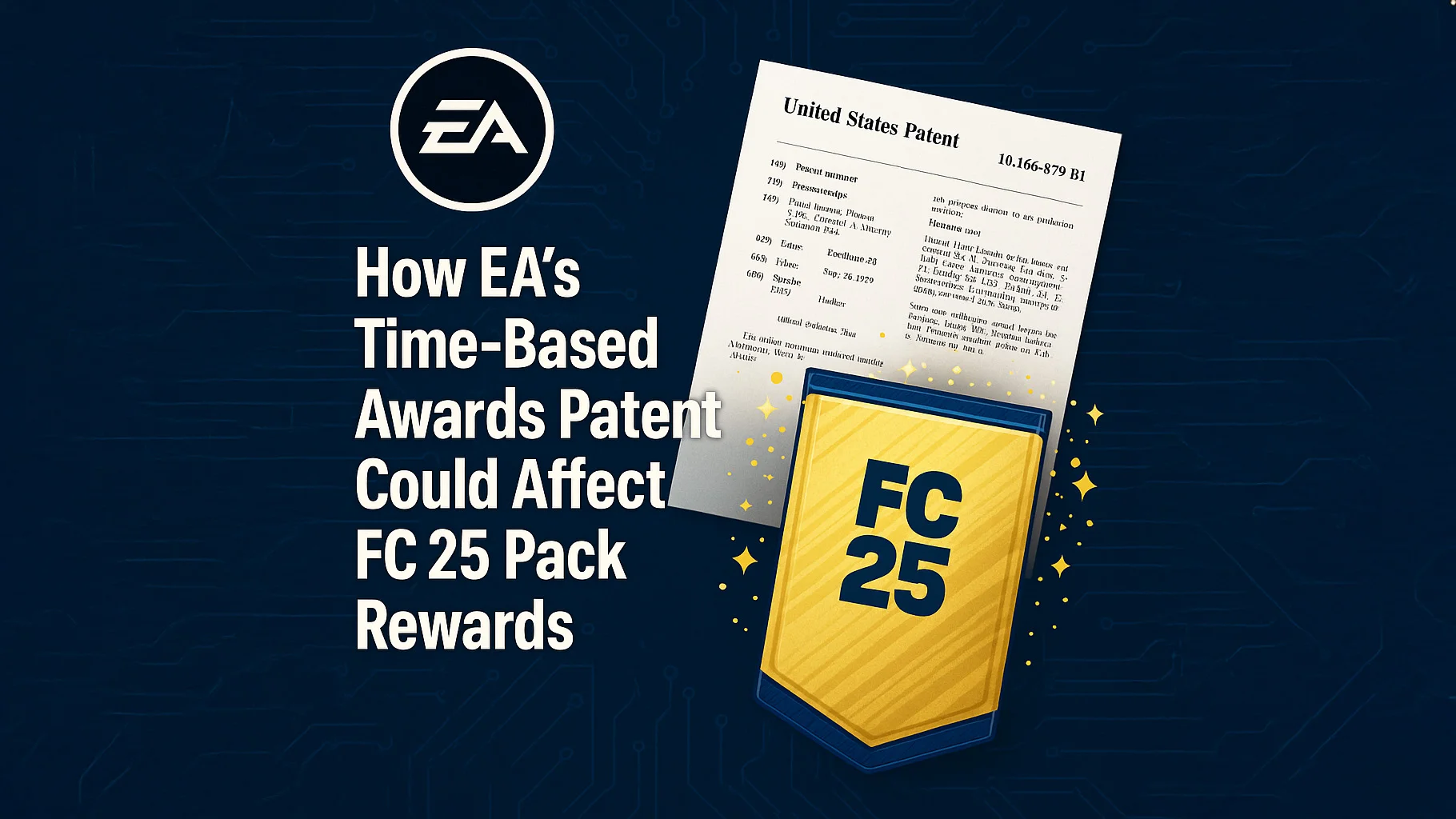
In the FIFA/FC community, an old EA patent is making waves again – and it might explain why your pack luck in FC 25 Ultimate Team sometimes feels anything but random. Casual players are buzzing about U.S. Patent 10,166,479 B1, titled “System and Method for the Provision of Time-Based Awards,” which describes dynamically adjusting in-game rewards based on player behavior. This patent, originally filed years ago by EA, has resurfaced thanks to community sleuthing and YouTube discussions, raising questions about how pack rewards are determined. In this article, we’ll break down what the patent entails, why it’s getting renewed attention, and what it could mean for the average Ultimate Team player.
Why Is Everyone Talking About This Patent Now?
In mid-2025, Ultimate Team fans began sharing evidence that pack rewards might not be purely random. A growing number of players felt that something was off – that some players consistently packed top cards with little effort, while others got only low-rated “fodder” despite grinding daily. It turns out EA has a patent describing exactly that kind of system, and the community is putting two and two together. The patent outlines a method to “dynamically generate and modify” rewards (like FUT packs) in real-time based on individual user behavior. In simple terms, the game could change what’s in your packs depending on how you play, when you play, and even if you spend money.
This revelation has huge implications for casual players. If the system is active, it means your pack luck might be tailored to maximize your engagement. That could explain why your friend who rarely logs in somehow packs a super-rare card, while you – logging in daily – keep pulling duplicates. It might also explain those times you come back from a break and immediately get a great pull. The renewed attention on this patent comes from community speculation (fueled by Reddit threads and YouTubers) that FC 25 Ultimate Team is using these tactics to keep players hooked. EA hasn’t confirmed any of this, but the mere possibility is enough to get FUT fans riled up.
How the System Works (In Plain English)
So what does the patent’s “time-based awards” system actually do? Let’s break down the five major mechanics that could be influencing your pack rewards, in terms anyone can understand. Essentially, the game might monitor your habits – how often you play, how quickly you complete challenges, your skill level, what you’ve packed before, and even your spending – and then tweak your FUT pack contents accordingly. Here are the key factors, explained:
- Time Between Tasks: Are you a slow-and-steady grinder or a quick completer? The patent suggests that how fast you finish in-game tasks (Squad Building Challenges, objectives, etc.) can affect your rewards. If you complete an SBC rapidly (say in one afternoon), the system might register you as an engaged player and reward you with a better pull. But if you drag the SBC out over a week, you might end up with a dud pack as a subtle nudge to play faster. For example, one FUT fan noted that taking a full week to finish a big SBC yielded him only a duplicate 84-rated card, whereas finishing a similar challenge in a single session got him a special promo player. In short, procrastinating in-game could lead to worse packs, while quick engagement might be rewarded.
- Gaming Frequency: How often you log in matters. Counterintuitive as it sounds, playing every single day might actually decrease your chances of huge pack pulls. Why? The system figures it doesn’t need to bribe you with a Cristiano Ronaldo TOTY if you’re already logging in religiously. On the flip side, if you’ve been inactive for a while, the game may throw you a bone – possibly a high-rated card – to re-hook your interest. Many players report exactly this experience: go AFK for a couple of weeks, then come back to find a 96-rated Team of the Season Pedri waiting in your pack. It’s like the game saying, “Hey, welcome back! Don’t leave again.” In essence, frequent players might see lower pack luck on average, while lapsed players get surprise jackpots to win them over.
- Player Skill/Tier: According to the patent, the system can classify players by skill or experience level – think beginner, intermediate, veteran, or pro tiers. Your reward quality might then be adjusted based on which bucket you fall into. New or lower-skill players could receive more “enticing” rewards (perhaps a big-name player in an early Division Rivals reward) as encouragement to stick around. But if you’re a seasoned FUT grinder smashing Elite Division or Rank 1 in Champions every week, the game knows you’re already motivated – so it might not give you that 97-rated TOTS superstar in your rewards, since you’d keep playing anyway. In other words, “beginner’s luck” might be by design: the game juices new players’ packs to hook them, while long-time veterans see more humble pulls because they’re already invested.
- Reward History (Hot/Cold Streaks): The system keeps a history of what you’ve packed – good cards, bad cards, how many packs you’ve opened, etc. – and it might actively balance your luck. This means if you hit a hot streak (say you packed several top-tier players in a short span), the algorithm could swing you into a cold streak to even things out. Conversely, if you’ve been in a long drought with nothing but low-rated cards, the system might loosen up the odds to drop something decent and revive your excitement (the patent implies maintaining a “balance” in rewards). Many FUT veterans swear by this: pack an ultra-rare card one day, and the next week everything is 84-rated or lower – not a coincidence, they say, but the system throttling your luck on purpose. The idea is to prevent one person from getting too lucky or too unlucky in a row. Your pack luck isn’t a series of independent rolls, if this holds true – it’s memory-based. That TOTY you packed last month? According to this theory, you might still be in “cool-down” mode, with mediocre rewards until the game decides you’re due for another hit.
- In-Game Behavior & Spending Habits: Perhaps most controversially, the patent notes that the system can analyze how you play and how you spend to adjust rewards. Everything from your tendency to quit matches or stop playing after frustration, to your spending patterns in the FUT Store, could factor in. For instance, if the system sees that you tend to shut off the game right after opening a terrible pack, it might flag that you’re discouraged and toss you a bone in your next pack to keep you from quitting entirely. On the other hand, if you’re happily grinding despite bad pulls, the game may feel no urgency to improve your luck. Even more directly, the patent acknowledges tracking real-money purchases: it knows how much you’ve spent on FIFA Points or expensive store packs and how often. Based on that, it can decide to sweeten or sour your future rewards. There’s a popular belief in the community that if you never spend cash, the game might “punish” you with worse pack odds until you do. But as soon as you buy a pack (even with coins), your next few packs suddenly improve. In effect, the algorithm might dangle a nice pull as a “thank you” (or tease) for spending, encouraging you to keep opening more. All of this falls under monitoring your behavior: whether you’re a rage-quitter or a big spender, the system can allegedly adjust your pack luck in real-time to maximize your engagement.
More Than Just RNG?
If all of the above sounds a bit scary, you’re not alone in thinking so. Ultimate Team has always been sold as a game of chance – you open packs and hope for the best. EA even publishes pack probability percentages and claims each pack is an independent chance, like a fair coin flip. Officially, opening multiple packs “does not change the likelihood” of getting a high-rated item and everyone has the same disclosed odds. However, this patent suggests something very different behind the scenes. It proposes an adaptive RNG that could favor or disfavor you based on your profile.
So far, EA has not confirmed that FC 25 (or any FIFA/FC title) uses this system, and it’s worth noting that companies patent many ideas that never make it into games. EA even publicly denied using “scripting” or Dynamic Difficulty in Ultimate Team matches after fan outcry and a lawsuit. But when it comes to pack rewards, there’s no clear denial. And the anecdotal evidence in the community is hard to ignore. The patterns described in the patent line up eerily well with what players have been experiencing in FUT 25. The feeling that pack luck gets worse right after you pack a star, or that returning from a break yields unusually good rewards, might not be your imagination. These stories have been shared in FUT forums for years, and now we might have the technical blueprint behind them.
Players across Reddit and forums have been comparing notes: for example, one user shared that he has two friends – one who sweats every objective and game mode and “packs basically nothing good,” and another who plays very casually but “constantly pulls top promo players”. That second friend, with minimal playtime, somehow lucks into stars like Vinícius Jr. and Pedri, while the hardcore grinder’s packs are comparatively awful. Another player recounted how he took a 5-week break mid-season, then in the week he came back he packed multiple high-rated cards (94 Bale, special Pedri, etc.), after having no luck in the months of regular play before. These anecdotes mirror the patent’s outlined mechanics on gaming frequency and reward balancing. There are also countless posts claiming that the first pack after spending money or the first pack of a new promo feels especially lucky – almost as if EA is turning up the pack weight at specific moments to get you hooked. For instance, many players believe that after you buy a pricey store pack (using coins or FIFA Points), your next few “free” packs will contain a walkout or special card, as if to say “see, spending was worth it!”. Similarly, during major promos like Team of the Year, some suspect that pack odds start high (letting a flurry of TOTYs get pulled to generate social media hype) and then get quietly nerfed later on – though EA’s disclosed probabilities only sometimes reflect small mid-promo changes.
Of course, not everyone is convinced. Skeptics argue that confirmation bias plays a big role – we remember the one time our buddy packed an icon after a hiatus, but forget the many times nothing happened. As one community member pointed out, just because a patent exists doesn’t mean it’s implemented, and EA’s business goal is to increase active players, not encourage them to take breaks. Why would EA deliberately give better rewards to people who play less, potentially incentivizing players to not play? It’s a valid question, and it means we should take these theories with a grain of salt. However, even the skeptics often admit that EA’s priority is maximizing profit and engagement – so if a reward-tweaking algorithm can be used to subtly push players to spend more or keep them from quitting, it’s not far-fetched to think EA would at least test or consider it. As one FIFA Infinity blog comment put it, there’s really “no such thing as randomness” in a data-driven system like this; companies routinely use data to target customers with different offers, so why wouldn’t EA?
Bottom line: pack luck in Ultimate Team might not be pure luck after all. It could be an invisible hand tuning the slots based on your behavior. Now, assuming this is true (even partially), the big question for players is – can we use this knowledge to our advantage? If the house (EA) always wins, can we at least improve our odds at the table? In the next section, we’ll dive into some practical tips that players are using to try to “exploit” the system and tilt that pack luck in their favor.
How to Exploit the System for Better Pack Luck
If EA’s dynamic reward system is indeed pulling the strings, savvy players might be able to game the algorithm (at least a little). While nothing is foolproof – and we have to stress that no one can guarantee a great pull – these strategies are based on the patent’s logic and years of community observations. Think of it as trying to beat the casino at its own game. Here’s a practical guide to potentially boost your pack luck:
- Speed-Run Your Objectives and SBCs: Don’t leave that Squad Building Challenge hanging for days. Complete content as quickly as you reasonably can. The theory is that the system rewards fast, engaged play with better packs. If you start an SBC or Objective, try to finish it in one session instead of procrastinating. Example: A player who finished a player SBC in one afternoon reported getting a special card in the reward pack, whereas when he stretched an SBC over a week he only got a low-rated duplicate. The takeaway – show the game you’re active, and it may pay out better.
- Take Strategic Breaks (Less Can Be More): It sounds crazy, but playing non-stop might be hurting your pack luck. Consider taking short breaks or skipping a day or two, especially if you’ve been grinding daily with poor rewards. The patent suggests the game will try to “win back” inactive players by boosting their rewards. Many fans swear that their best pulls come right after a hiatus. So if your pack luck has been awful, try logging off for a few days. Also, don’t chase losses in the same session – if you just ripped 10 packs and got nothing, step away and try again tomorrow. The system might notice you quit out of frustration and improve your odds next time you open packs. In short, periodic breaks – both short-term and long – could “reset” your luck and trigger that elusive big pull when you return.
- Leverage New-Player Luck (if you can): The game appears to favor newer or less skilled accounts with juicier rewards. Obviously, you can’t fake being a newbie on your main account, but you can take advantage of this in a couple ways. If you have a friend who’s new to FC 25, team up when they open packs – you might witness the beginner’s luck phenomenon (and maybe enjoy some of the spoils if you share teams). Some hardcore players even create secondary “Road to Glory” accounts each year to see if lower-tier profiles get better pack pulls (anecdotally, they often do get a crazy card early on). This tip is more about managing expectations: if you’re a long-time veteran, understand that the game might not “waste” marquee cards on you early since it knows you’re sticking around. But on a fresh account, the floodgates could open. Alternate accounts or playing on a friend’s new account won’t magically transfer luck to your main, but it can confirm the pattern and give you insight into how the system doles out rewards by player tier.
- Manage Your Hot and Cold Streaks: Be aware of your recent pack luck, and plan your openings accordingly. If you just packed a top-tier player (e.g. you hit a Hero or Icon in a pack), recognize that you might be entering a “cool down” period where the next bunch of packs will be deliberately mediocre. You might choose to hold off on ripping more packs immediately after a jackpot, to avoid wasting them during a likely cold streak. Conversely, if you’ve opened 50 packs in a row without anything above an 85, you could be on the verge of the algorithm deciding to throw you a bone (since it “owes” you to keep you engaged). Some players save their best packs for when they feel “due” for a big pull. While every pack should be independent, under this system your past luck (good or bad) influences future luck. So try timing your pack openings: open more when you’ve been cold (hoping for that rebound), and maybe ease up after hitting something huge.
- Spend (Smartly) – or At Least Mimic Spending: This one’s tricky, and we’re not advocating blowing your money on FIFA Points. But here’s the deal: if the system is withholding good cards because you’ve never spent a cent, then making a small, strategic purchase might break the curse. Many in the community believe that buying even a single store pack (with real money or a chunk of saved coins) can suddenly improve the RNG of subsequent packs. It’s as if you prove to EA you’re willing to spend, and they reward you with a taste of glory to encourage more. If you’re strictly free-to-play and feeling unlucky, you could try using some FUT coins on a promo pack when one is available, just to see if your luck turns. Important: Only do this within your means – the goal is a one-time “stimulus,” not a habit. Also, consider that occasional small spending might be better than being a whale; if you dump hundreds of dollars regularly, the algorithm might figure it doesn’t need to gift you anything because you’ll spend regardless. One ex-FUT whale commented that after seeing this patent, he realized constant big spending might actually hurt pack luck, and that EA could move toward personalized pricing or offers based on your spending cohort. The sweet spot might be spending just enough that the system values you, then pausing. In practice: toss a few bucks or coins at a pack when you’re desperate, but don’t go broke chasing the dragon. If the theory holds, you might just get that big pull right after you show EA a little $$$ love.
- Play (and Quit) on Your Terms: Another behavioral exploit is to use the algorithm’s psychology against it. The system wants to keep you playing, so it may adjust if it thinks you’re about to quit. Therefore, you hold the ultimate power by deciding when to walk away. For example, if a string of bad games or packs has killed your vibe, don’t push on – call it a night. There’s a decent chance the next time you log in, the game will serve up something good to win you back. Similarly, if you’re on a huge winning streak in gameplay but not packing anything, that might be the game assuming you’re happy. It sounds odd, but some players even intentionally lose a match or two or drop divisions (where it doesn’t impact rewards too badly) to see if a slightly “struggling” profile gets kinder pack RNG. While this is speculative, the underlying tip is: don’t always show the game you’re content. If you’re too good or too persistent, the algorithm might take you for granted. By occasionally easing up and resetting (whether that’s taking losses in stride or pausing play), you might trigger the system to throw you a cookie.
Remember, all these tips are attempts to nudge an unseen algorithm – your mileage may vary. The goal is to align your behavior with what the patent suggests the system rewards: consistent engagement but not too consistent, a little bit of spending but not whale-level, and a profile that isn’t “maxed out” on skill or recent luck. Essentially, you want to appear to the system like a valuable but at-risk player: someone who could leave if not treated well, and who could spend if enticed with good fortune. That profile, if this patent is truly in play, is the one most likely to get showered with better pack odds.
🎮 FAQ: FC 25 Pack Luck & EA’s Reward System
How does EA’s patent impact pack luck?
EA’s patent suggests pack contents could adjust based on your gameplay patterns, not just random chance. EA hasn’t confirmed its use in FC 25, but many players suspect it’s active.
What player actions might affect packs?
- Task completion speed (SBCs/Objectives)
- Gaming frequency (daily vs. occasional)
- Skill level (beginner vs. veteran)
- Recent pack history (hot/cold streaks)
- Spending behavior (coins/FC Points)
Does taking breaks boost pack odds?
Possibly. Players often report better packs after a break, matching the patent’s logic of re-engaging inactive users.
Can spending money improve pack luck?
Potentially yes. The patent mentions rewards adjusting based on spending patterns, aligning with community experiences.
How can I exploit this to get better packs?
- Finish tasks quickly.
- Take short breaks occasionally.
- Make occasional small store purchases.
- Open packs strategically after bad luck streaks.
- Avoid long sessions immediately after big pulls.
Comments